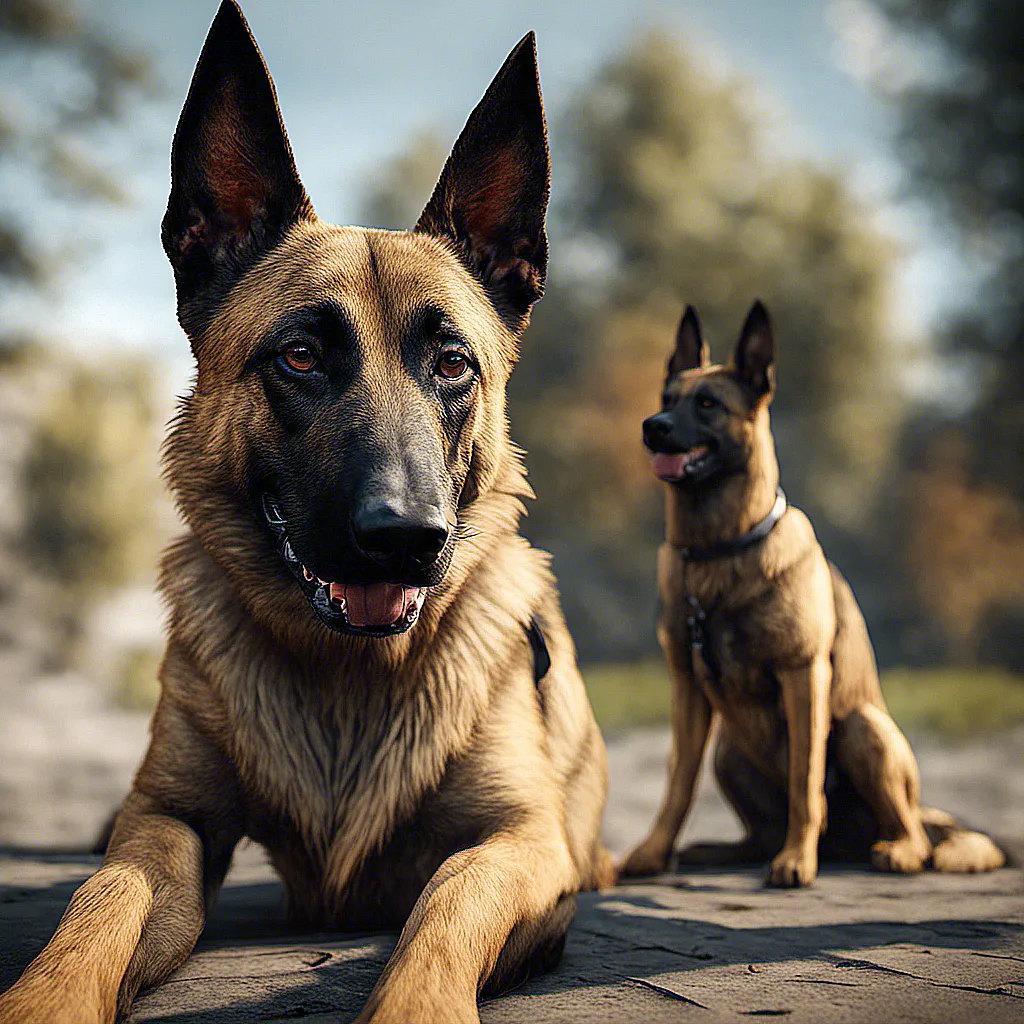
German Shepherd vs Belgian Malinois: Performance, Deployment Rates & Service Records Compared
They look like cousins at first glance. Same upright ears, same confident stride, same intensity in those eyes. But ask any Special Forces handler which dog they want on a midnight raid — and you’ll get a very specific answer.
The German Shepherd (GSD) and Belgian Malinois are the two most widely deployed working dog breeds in the world. Both serve in police units, military operations, search and rescue teams, and elite government agencies. But they are not the same dog. Not even close, when the stakes are high.
This article digs into the real data — performance studies, deployment records, K9 statistics, and mission-specific preferences. Whether you’re a handler choosing your next partner, a researcher, or someone just deeply curious about these remarkable animals, this is the most complete working-dog comparison you’ll find.

At a Glance: Key Differences Between GSD and Belgian Malinois
Before we get into the numbers, here’s a quick breakdown:
- Weight: German Shepherd 65–90 lbs vs Belgian Malinois 40–80 lbs
- Build: GSD is stockier, more muscular; Malinois is leaner, more aerodynamic
- Working life: GSD 6–9 years; Belgian Malinois 8–10 years
- Lifespan: GSD averages 9–13 years; Malinois averages 10–14 years
- Bite force: GSD ~360.4 N median; Malinois ~247.0 N (PubMed controlled study, 2021)
- Primary strength: GSD — raw power, versatility; Malinois — speed, endurance, agility
Neither breed is “better” across the board. They’re optimized differently. And that difference matters a lot when lives are on the line.
Physical Build and Performance Metrics
Body Composition and Speed
The German Shepherd carries significantly more muscle mass, particularly in the chest. That gives it a raw power advantage in apprehension work — its bite force has been scientifically measured at a median of 360.4 Newtons in a controlled study of Finnish police dogs (Heikkilä et al., PubMed, 2021). The Belgian Malinois, by comparison, clocked in at 247.0 N in the same study.
So yes, the GSD bites harder. But that’s not why the Malinois has taken over elite units.
The Malinois is built for sustained performance. Its lighter, leaner frame means it can run faster, jump higher, and maintain high output for longer periods without fatigue. Think of the GSD as a powerlifter and the Malinois as a decathlete. Both extraordinary — just trained for different events.
Agility and Endurance
Belgian Malinois are described by handlers as capable of running “hard all day and still having energy left over.” This isn’t hyperbole. In deployment terms, it means:
- They can execute multiple sweeps of large areas without rest breaks
- They recover faster between intense work sessions
- Their lighter frame (compared to the GSD) causes less strain on joints during prolonged fieldwork
The Malinois also has a notable physical advantage for airborne operations — their compact, lighter frame makes tandem parachute jumping and rappelling significantly easier than it is for the heavier GSD. This is a documented reason the Belgian Malinois became the standard breed for Navy SEAL Combat Assault Dog (CAD) teams.
Military Deployment Data: Who’s Actually Getting the Call?
Here’s where the data gets clear.
The Belgian Malinois is the predominant breed used by U.S. Navy SEAL teams and other Special Operations Forces (SOF). The Navy SEAL Museum officially confirms this: “The Belgian Malinois is the predominant breed utilized by SEAL Teams. Their compact size and lightning speed help create a tactical advantage.”
The breed gained global visibility with Cairo, the Belgian Malinois who accompanied SEAL Team Six during Operation Neptune Spear in 2011 — the raid that resulted in the death of Osama bin Laden. Cairo’s role included tracking escape routes, detecting hidden compartments, and backing up the operators during the compound clearance.
In 2019, another Belgian Malinois — Conan — played a key role in the Operation Kayla Mueller raid targeting ISIS leader Abu Bakr al-Baghdadi. Conan chased al-Baghdadi into a tunnel, directly contributing to the mission’s outcome. He served with Delta Force (1st SFOD-D) until 2023.
Only 1% of Belgian Malinois dogs successfully complete the selection and training process to become Combat Assault Dogs (CADs) in Special Operations units. That’s an extraordinarily demanding filter — and it tells you something about the intensity of what these dogs are expected to do.
Why the Malinois, Not the GSD, for Elite Missions?
Several practical reasons drive this preference at the tier-one level:
- Weight advantage in tandem jumps — Operators jumping with a dog attached face less strain with a 55-lb Malinois than a 90-lb GSD
- Sustained speed in pursuit — Critical during compound clearances where a fleeing target can create a life-threatening delay
- Heat tolerance and endurance — Important in Middle East deployment environments
- Longer peak performance window — Malinois typically hit their operational peak between ages 3–7 and maintain it longer than GSDs
The broader U.S. military still uses German Shepherds in various capacities — particularly for patrol and detection roles where the GSD’s proven track record and calm temperament are valued. But for the highest-risk, most physically demanding missions, the Malinois has become the clear preference.
Police K9 Deployment Data (2024–2026)
Here are the numbers from the most recent available data:
- Belgian Malinois now make up 72% of active police K9 units in the United States
- There are approximately 50,000 police dogs actively serving law enforcement agencies across the U.S.
- German Shepherds remain the most recognized police dog breed globally, but have steadily ceded ground to the Malinois in active deployment
The U.S. Secret Service, TSA, and military branches have largely transitioned their primary working breeds away from German Shepherds toward Malinois, citing “faster training timelines and longer peak-performance windows,” according to a 2026 K-9 demographics report.
India’s Central Reserve Police Force (CRPF) reports an even more dramatic shift — approximately 90% of their canine units now consist of Belgian Malinois.
Performance Statistics for Police K9 Work
- German Shepherds show a 92% success rate in suspect apprehension tasks, compared to 88% across other breeds — one area where the GSD’s stronger bite force and intimidating presence work in its favor
- 85% of certified police K9s pass narcotics detection tests on the first attempt after 16 weeks of training — a stat that applies roughly equally to both breeds
- The average training time before K9 certification is 1,200 hours
- Police K9s have an average career length of 8–10 years before retirement (Malinois tend toward the higher end)
- Injury rates for police K9s dropped 15% from 2018–2022, largely due to improved body armor and tactical protocols
What Role Each Breed Dominates
German Shepherd strengths in law enforcement:
- Suspect apprehension (higher bite force = greater deterrence and stopping power)
- Community-facing roles (calmer temperament reduces liability)
- Search and rescue operations (excellent scent tracking combined with physical stamina)
- General patrol work in moderate-intensity environments
Belgian Malinois strengths in law enforcement:
- High-intensity tactical operations (SWAT, rapid deployment)
- Explosives and narcotics detection (exceptional focus and drive)
- Long-duration tracking operations
- Airport and border security (sustained alertness)
- Federal agency work (TSA, Secret Service, DEA)
Training Requirements: Which Dog Is Easier to Work With?
This is where the GSD often gets the nod for broader deployment.
German Shepherds are considered more manageable for a wider range of handlers. They’re ranked 3rd on the American Kennel Club’s intelligence list and bond strongly with their handlers. They can transition more naturally between high-intensity work and quieter environments — important for dogs that also live with families or work in varied settings.
Belgian Malinois, by contrast, demand experienced handlers. They learn faster in many cases — often anticipating commands before they’re given — but that intensity cuts both ways. Inconsistent training creates reactivity and frustration in Mals. They’re not forgiving of handler mistakes the way a GSD sometimes is.
6 key training differences:
- Belgian Malinois require more daily exercise (3–4 hours minimum for working lines)
- GSDs adapt better to multiple handler types, including less-experienced ones
- Malinois are more prone to behavioral issues when under-stimulated
- GSDs can switch between active duty and calmer environments more smoothly
- Malinois thrive on routine and repetition — great for specialized detection roles
- GSDs show more independent problem-solving, which helps in search and rescue
Health, Longevity, and Career Costs
This is arguably the most underreported part of the GSD vs Malinois debate in working dog programs.
German Shepherds carry a 20% hip dysplasia rate according to the Canine Health Information Center. They’re also susceptible to degenerative myelopathy, bloat, cancer, and elbow dysplasia. These conditions significantly affect career length and operational readiness.
Belgian Malinois have a notably cleaner health profile. While they can develop hip and elbow dysplasia and some eye conditions, the rate of serious structural problems is lower. This directly translates to:
- Longer active service windows (8–10 years vs 6–9 years for GSDs)
- Lower lifetime veterinary costs
- Less risk of mid-career medical retirement
For agencies managing K9 programs at scale, this is a real operational and budget consideration. The Global Police Dog (K9) Market is projected to grow at a 5.05% CAGR from 2025–2035, and working dog training services are expected to reach a $1.7 billion global market by 2030 — cost efficiency matters.
German Shepherd hip dysplasia prevention
Which Breed Wins in Each Role?
Let’s be direct about this.
Choose the Belgian Malinois if you need:
- Elite military operations (special forces, tier-one units)
- High-intensity tactical police work (SWAT, federal agencies)
- Sustained endurance in demanding physical environments
- A dog with a longer operational career and lower health risk
- Airborne or maritime special operations
Choose the German Shepherd if you need:
- Versatile law enforcement work across varied environments
- A dog that works well with less specialized handlers
- Search and rescue operations where physical presence and scent work combine
- Apprehension roles where raw bite force and deterrence are primary
- A dog that transitions between working and family environments
The honest answer? Most elite units have already made their choice. The shift toward Malinois at the federal and special operations level is not a trend — it’s an established operational standard. The GSD remains irreplaceable in many conventional law enforcement and community policing contexts.
A Quick Word on Famous Working Dogs
Some of the most decorated working dogs in U.S. history have been Belgian Malinois:
- Cairo — accompanied SEAL Team Six during Operation Neptune Spear (2011)
- Conan — Delta Force, participated in the al-Baghdadi raid (2019), served until 2023
- Hurricane — U.S. Secret Service, considered the most decorated dog in American history, passed away February 2025 at age 15
These aren’t anecdotes. They’re data points about which breed gets selected when the mission margin for error is zero.
Conclusion: The Right Dog for the Right Mission
The German Shepherd vs Belgian Malinois debate doesn’t have a clean winner. What it has is context.
If you’re building an elite special operations K9 program, the data is overwhelming — the Malinois wins. Faster, lighter, longer-lasting, and built for the sustained intensity of modern tactical operations.
If you’re staffing a versatile law enforcement K9 unit, the GSD still holds real value — especially for community-facing roles, search and rescue, and contexts where handlers have varied experience levels.
Both breeds are extraordinary. Both deserve the respect they’ve earned through decades of service. But when people ask which dog the elite units actually call on for the most demanding missions — that answer has become very clear.
| Performance Metric | German Shepherd | Belgian Malinois | Advantage |
|---|---|---|---|
| Bite Force (scientific study, Newtons) | 360.4 N | 247.0 N | GSD |
| Working Career Length (years) | 6–9 | 8–10 | Malinois |
| Agility & Speed | High | Very High | Malinois |
| Endurance/Sustained Output | High | Very High | Malinois |
| Handler Accessibility | Very High | Moderate | GSD |
| Health Profile (fewer conditions) | Moderate | High | Malinois |
| Versatility (role range) | Very High | High | GSD |
| Elite Military Preference | Secondary | Primary | Malinois |
Source Notes: Bite force data from Heikkilä et al. (PubMed, 2021), 20-dog Finnish police dog study. Career length and health data from Canine Health Information Center, K-9 demographics reports 2024–2026.
FAQ: German Shepherd vs Belgian Malinois for Military and Police Work
Q1: Why do Navy SEALs prefer Belgian Malinois over German Shepherds?
Belgian Malinois are preferred by Navy SEALs and other Special Operations Forces primarily because of their lighter weight and compact build — which makes tandem parachute jumping and rappelling much more practical. Their superior sustained speed and endurance also make them better suited for the intense, prolonged physical demands of tier-one operations. The GSD is heavier and carries more structural health risk, which shortens its elite operational window.
Q2: Do Belgian Malinois really make up 72% of U.S. police K9 units?
Yes, according to 2025–2026 K9 deployment data aggregated from the North American Police Work Dog Association (NAPWDA) and FOIA disclosures. The shift has been particularly sharp at the federal level, where agencies like the TSA, Secret Service, and DEA have largely transitioned from German Shepherds to Malinois for patrol and protection roles.
Q3: Which breed has a stronger bite — GSD or Belgian Malinois?
The German Shepherd has a significantly stronger bite force. A controlled scientific study published on PubMed (Heikkilä et al., 2021) measured the bite force of 7 German Shepherd Dogs and 13 Belgian Malinois during a modified long attack exercise. The GSD recorded a median bite force of 360.4 Newtons; the Malinois recorded 247.0 Newtons. In PSI terms, the GSD is commonly cited at approximately 238 PSI vs the Malinois at approximately 195 PSI.
Q4: Are Belgian Malinois healthier than German Shepherds?
Generally, yes. German Shepherds carry a documented 20% hip dysplasia rate and are prone to additional conditions including degenerative myelopathy, bloat, cancer, and elbow dysplasia. Belgian Malinois have a cleaner health profile with fewer structural issues, which directly contributes to their longer working career (8–10 years vs 6–9 years for GSDs) and lower lifetime veterinary costs.
Q5: Can a German Shepherd perform the same missions as a Belgian Malinois in the military?
For most conventional military working dog (MWD) roles — patrol, detection, tracking — yes. German Shepherds are still widely used across the broader U.S. military. However, for the highest-demand special operations missions (airborne insertion, rapid tactical assault, prolonged desert deployment), the Malinois is the preferred choice due to physical attributes that the GSD simply doesn’t match.
Q6: Which breed is better for a first-time working dog handler?
The German Shepherd is generally more suitable for less-experienced handlers. The Belgian Malinois demands experienced, structured training and a handler who can meet its intense exercise and mental stimulation needs (3–4+ hours daily for working lines). An improperly managed Malinois can become reactive and difficult to control. The GSD is more forgiving and adapts better to varied handler skill levels.