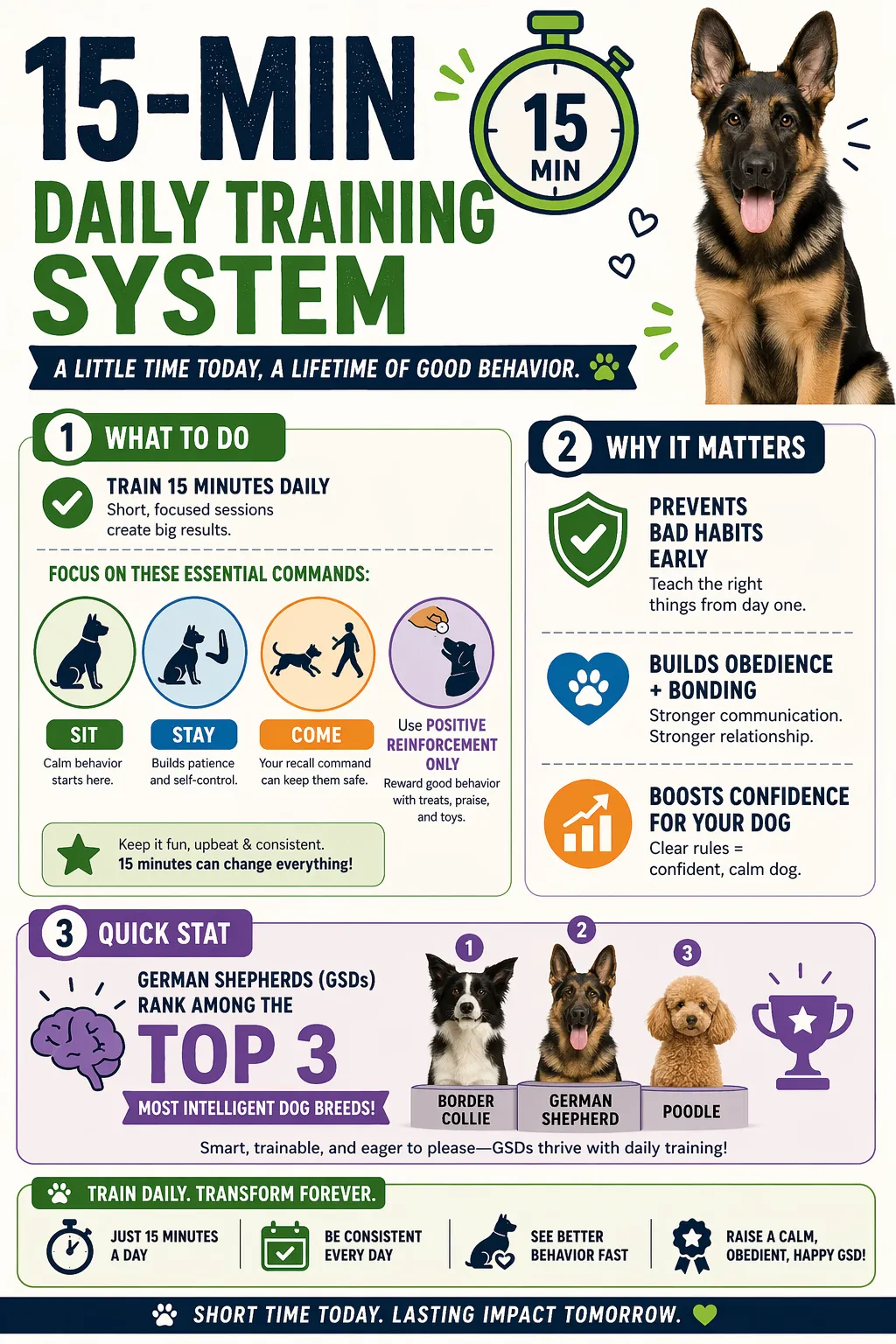
How to Prepare Your German Shepherd for a Wedding Day: Training, Socialization & Essential Tips
Your German Shepherd has been there for the ordinary days. It makes sense you want them there for this one too. But this breed isn’t wired like a Labrador that greets a crowd with a full-body wag. German Shepherds are bred for watchfulness, and that instinct doesn’t take a day off just because there’s a cake and a string quartet.
What does it mean to prepare a German Shepherd for a wedding? It means building calm, reliable behavior around crowds, noise, and unfamiliar touch through weeks of gradual desensitization, then managing your dog’s role, environment, and supervision on the day itself so natural protective instincts don’t turn a joyful moment stressful. Done right, it’s one of the most rewarding things you’ll train your dog for. Done last-minute, it’s a recipe for a dog who spends the ceremony straining at the leash.
Here’s a full plan: what the breed brings to the table, a week-by-week training countdown, a way to score your dog’s actual readiness, and what to do if the honest answer is “not yet.”
Is Your German Shepherd Cut Out for Wedding Day?
The AKC breed standard describes the ideal German Shepherd temperament as confident and approachable, with a “certain aloofness” that isn’t the same as suspicion or fear — direct and fearless without hostility, self-confident, and not prone to immediate, indiscriminate friendliness. That’s the breed working as intended. The catch is that many GSDs seen by trainers and behavior consultants show more neurotic patterns than the standard describes — aggression, skittishness, and extreme fearfulness, usually traced back to limited early socialization or genetics rather than “bad temperament” in a fixed sense.
That’s actually good news for wedding prep. A well-bred, well-socialized GSD can absolutely handle a wedding. A dog that hides, trembles, or reacts defensively toward strangers isn’t showing “protective instinct” — it’s showing fear, not the confident wariness the breed is known for. Your job over the next several weeks is to figure out which dog you have, and build toward the first one.
The Behavior Science: Fear vs. Protective Instinct
Before you train anything, learn to tell these apart, because they call for different responses.
A veterinary-behavior source studying GSD training patterns notes a common mistake: don’t label fear as “protective,” frantic scanning as “high drive,” or defensive behavior as “dominance” — those labels can reward unsafe behavior and delay proper treatment. A dog that backs away, barks at strangers repeatedly, or can’t settle after a startle is likely afraid, not guarding.
This distinction matters because fear-based reactivity in GSDs is frequently misread as confidence — a dog that barks and lunges at strangers isn’t necessarily being bold; in most cases the behavior is driven by fear and the instinct to make a perceived threat retreat. If your dog shows this pattern regularly, wedding prep starts with a certified trainer or veterinary behaviorist, not a DIY countdown.
The 12-Week Aisle-Ready Countdown
Rushed desensitization is the single biggest reason wedding-day plans fall apart. The research backs this up directly: a controlled study on companion dogs found that even a structured four-week desensitization and counter-conditioning program produced only partial improvement in fear responses, with owner compliance being the biggest limiting factor — trained dogs showed less defensive posture than untrained dogs, but the changes were gradual and incomplete even after a full month of consistent work. Give yourself more runway than you think you need.
Weeks 12–9: Foundation
- Start short desensitization sessions to your dog’s specific triggers — crowds, applause, unfamiliar touch, formalwear. Behaviorists recommend keeping these short and frequent, 5 to 15 minutes long, 3 to 5 times a week or more.
- Introduce wedding-specific props at home: a leash your dog hasn’t seen, a collar or bandana, the sound of a speaker or music.
- Log each session — trigger, distance, and your dog’s body language — so you can see real progress instead of guessing.
Weeks 8–5: Building reps
4. Practice greeting unfamiliar people at a distance your dog can handle without reacting, then slowly close the gap over sessions — never all at once.
5. Rehearse “settle on a mat” in increasingly distracting environments (a park, a pet store, a friend’s porch).
6. If your dog will wear an outfit or carry rings, let them wear it around the house first.
Weeks 4–2: Simulation
7. Do a full dry run: crowd noise, formalwear, a stranger approaching, and a “quiet space” retreat, all in one session.
8. Visit the actual venue if possible, at a quiet time, so it isn’t a totally new environment on the day. If you’re still selecting a venue, choosing a pet-friendly location with spacious gardens and experienced wedding staff—such as “Settlers Country Manor” a wedding venue in Auckland —can make it much easier for both you and your German Shepherd to feel relaxed on the big day.
9. Confirm who’s handling the dog during the ceremony — never assume a member of the wedding party who’s also a guest can double as a handler.
Final week and day-of
10. Stop introducing anything new. This is reinforcement only.
11. Feed a normal meal and give a solid exercise session before the event — a tired dog handles novelty better than a wound-up one.
12. Set up a designated quiet space away from the crowd, with water, and a planned exit point if things get overwhelming.

The Aisle-Ready Score: A Framework for Knowing If Your Dog Is Ready
Vague confidence isn’t a plan. Score your dog honestly across these five criteria (0–4 each, 20 total) about two weeks out:
| Criteria | 0 (Not ready) | 2 (Getting there) | 4 (Ready) |
| Stranger greeting | Barks/lunges at unfamiliar people | Settles within 1–2 minutes | Calm within seconds, no prompting |
| Handles physical touch from non-owners | Avoids or growls | Tolerates briefly | Relaxed, leans in |
| Recovery after a startle (noise, sudden movement) | Stays aroused for minutes | Recovers in under a minute | Recovers almost immediately |
| Settles on cue in a distracting environment | Can’t hold a down-stay | Holds with reminders | Holds independently |
| Handler control at a distance | Pulls, ignores recall | Responds with effort | Responds first time |
15–20: Ready for full participation. 8–14: Ready for a shorter, more controlled role — the ceremony only, then handed off. Under 8: Skip attendance this time, or bring in a certified trainer for focused work before revisiting.
Managing the Protective Instinct Around Guests
Use the threshold technique: find the distance at which your dog notices a stranger but doesn’t react, reward calm behavior at that distance, then close the gap by a few feet only once your dog is consistently relaxed — never before. This mirrors the standard veterinary approach to counter-conditioning, where the exposure only advances once the pet is still readily taking treats and settling on cue; if it stops doing either, you’re moving too fast. Pushing past that point risks sensitization — making the fear response worse, not better.
Introduce your dog to the wedding party and immediate family individually, well before the event, rather than for the first time in a crowd. A GSD that’s cautious with new people typically needs a few minutes to assess and settle once it sees the owner is relaxed — watching carefully, staying a little closer than usual, and settling once it has read the room. That’s normal. Constant hyper-vigilance that never resolves is not, and it’s worth a trainer’s input.
Choosing Your Dog’s Role: Ring Bearer, Guest, or Stay Home?
This is where honesty pays off. Recent industry research found that over 80% of couples want to include a pet in their wedding, but only around 20% actually succeed, largely because of venue logistics. Don’t let your dog become one of the 60% who wanted to but couldn’t plan around it — or the version of “included” that means an overwhelmed dog in the corner of every photo.
- Full participation (ceremony + reception): Only for dogs scoring 15+ on the Aisle-Ready framework, with a dedicated handler who isn’t also a guest.
- Ceremony only, then handoff: A strong middle ground for dogs scoring 8–14 — present for the meaningful moment, removed before reception noise and alcohol change the environment.
- Photos only, off-site or before guests arrive: Lets you get the photo you want without exposing a dog that isn’t ready to a live crowd.
- Stay home with a sitter: Not a failure. It’s the right call for a dog that scores under 8, and it protects both your dog’s wellbeing and your peace of mind on the day.
Should You Hire a Professional Wedding Pet Attendant?
If your role in the day means you can’t personally manage the dog, a dedicated handler is worth pricing out. Rates vary by market and package:
| Service level | Typical cost | What’s included |
| Basic day-of handling | $200–$350 | Exercise before arrival, tidy-up, on-site handling for photos |
| Standard package | $350–$475 | Above, plus aisle escorting and reception supervision |
| Full-service (multi-day) | $475–$650+ | Rehearsal attendance, transport, overnight care, styling |
These figures reflect current market rates from wedding-pet-service providers, including packages starting around $350 covering pre-venue exercise, tidy-up, and roughly an hour of on-site photo handling, starting rates near $475 for full aisle escorting, photo support, and day-long care, and independent chaperones charging in the $125–$635 range depending on scope. It’s a genuinely growing niche — one UK-based chaperone reported booking 50 weddings in a single year at roughly $400 a day, largely through word of mouth.
A professional handler makes the most sense if: no member of your wedding party can reliably manage your dog, your venue has strict logistics (multiple locations, tight timing), or your dog scores in the “getting there” range and needs an experienced handler’s judgment in the moment.
Wedding Day Essentials Checklist
- Leash, backup leash, and a well-fitted collar or harness (don’t debut new gear on the day)
- High-value treats your dog doesn’t get otherwise
- A designated quiet space, away from the dance floor and speakers
- Water and a travel bowl
- A clear handler assignment, confirmed in writing, not assumed
- A planned exit route if your dog needs to leave
- Waste bags, and a plan for bathroom breaks on a schedule, not “whenever”
- Shade and water access if the event is outdoors, since large, double-coated breeds overheat faster than guests expect
Common Mistakes That Derail a Wedding-Ready German Shepherd
- Starting training in the final two weeks. The research is consistent: real behavior change takes sustained weeks, not days.
- Assuming a bridesmaid or groomsman can “just handle it.” They have their own job that day. Your dog needs someone whose only job is the dog.
- Skipping the venue visit. A totally novel environment on top of a crowd is a lot to ask, even of a well-prepared dog.
- Pushing past your dog’s threshold “just this once.” One bad exposure can undo weeks of careful counter-conditioning.
- No exit plan. If there’s nowhere to retreat to when things get overwhelming, there’s no safety net.
The Bottom Line
A German Shepherd can absolutely be part of your wedding day — but this breed’s temperament means “prepared” has to mean something specific: weeks of real desensitization, an honest readiness assessment, and a role that matches what your dog can actually handle, not just what you’re hoping for. Start the countdown early, score your dog honestly, and build a day-of plan with a real exit route. That’s what turns “I hope this goes okay” into a dog who’s genuinely, calmly part of the moment.